


‘Why Data Analysis Is Art’: HSE University–St Petersburg Hosts International School on Statistics
Why do statistical methods sometimes yield unexpected results? How does the creative approach help to process data in complex linguistic research? Is there 'a magic button' to analyse the results? The answers to these and other questions were the topic of the three-day autumn school 'Statistics in Psycho- and Neurolinguistics.'

HSE Participates in Conference on International Exchange of Professionals in China
From October 21 to 24, 2025, the 23rd Conference on International Exchange of Professionals took place in Shanghai and Beijing, bringing together more than 7,000 scientists and experts from around the world. HSE University was represented by Ivan Arzhantsev, Dean of the Faculty of Computer Science, and Vasily Gromov, Head of the Laboratory for Semantic Analysis of the Centre for Language and Semantic Technologies.

‘Our Task Is to Promote and Popularise Native Languages’
The Centre for the Study of Native Languages at Dagestan State University (DSU) is actively engaged in researching the many languages spoken by the peoples of Dagestan. The republic has 14 official state languages, many of which have their own dialects and varieties. Scholars from Dagestan plan to adopt corpus-based methods of linguistic research used at HSE University and intend to collaborate with HSE’s Linguistic Convergence Laboratory. The HSE News Service spoke with the centre’s Director, Prof. Marina Gasanova, who is currently undertaking a research placement at HSE University.
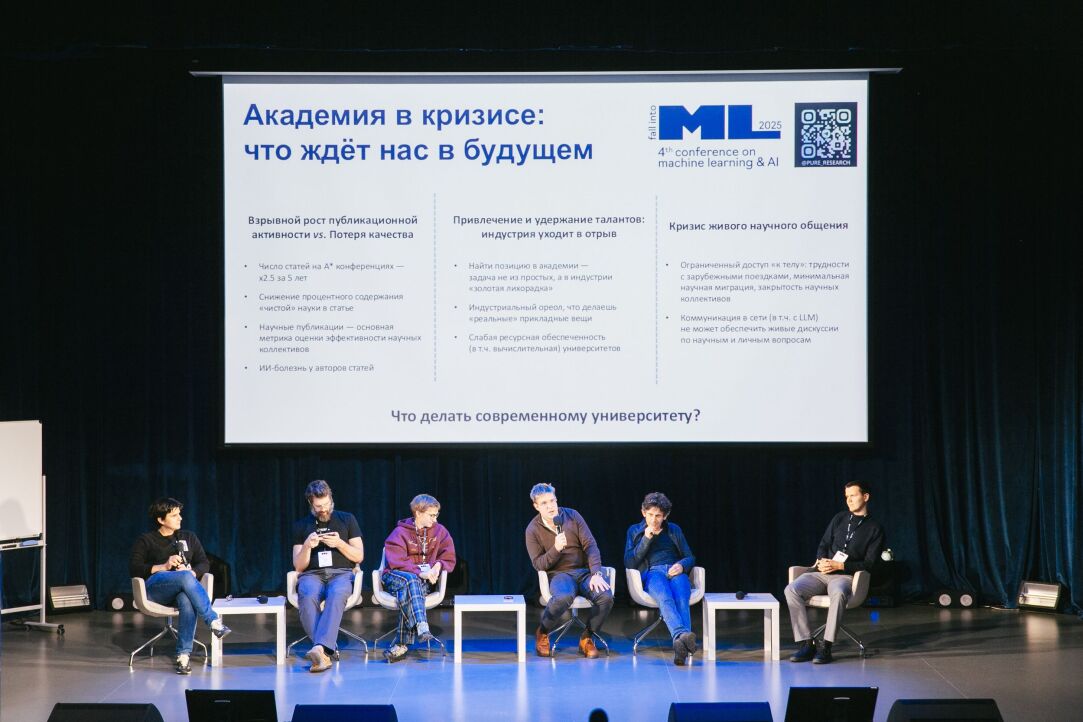
Quantity over Quality: How Publication Activity Leads to Crisis
Participants of the 4th Fall into ML conference at HSE University held a discussion titled ‘Academia in Crisis: What Does the Future Hold?’ In particular, they examined why the number of scientific publications continues to grow, what the quality of these papers is, what expectations should be placed on researchers, and what role artificial intelligence plays in preparing academic articles.

How Colour Affects Pricing: Why Art Collectors Pay More for Blue
Economists from HSE University, St Petersburg State University, and the University of Florida have found which colours in abstract paintings increase their market value. An analysis of thousands of canvases sold at auctions revealed that buyers place a higher value on blue and favour bright, saturated palettes, while showing less appreciation for traditional colour schemes. The article has been published in Information Systems Frontiers.

‘Fall into ML Has Firmly Established Itself as a Landmark Event in Russia’s AI Scene’
On October 24–25, 2025, the AI and Digital Science Institute of the HSE Faculty of Computer Science will host the fourth annual Fall into ML 2025 conference at the HSE Cultural Centre. The event is once again supported by its general partner, Sber. The focus this year is on breakthrough research and the future of fundamental AI.

'We Are Not Trying to Guess the Future—We Are Creating It': HSE University Experts Discuss 21st-Century Trends and Scenarios
Experts from HSE University participated in the II International Symposium 'Inventing the Future.' During the panel discussion 'Horizons of the Future: Trends, Challenges, and Scenarios,' organised by the HSE Institute for Statistical Studies and Economics of Knowledge (ISSEK), researchers explored the role of foresight and big data analysis in shaping visions of the future and identifying global megatrends that will drive the world’s development in the coming decades.
Applications to Participate in April International Academic Conference Now Open
HSE University is now accepting proposals to present academic reports at the XXVI April International Academic Conference named after Evgeny Yasin. Applications can be submitted until December 16, 2025. The conference events will take place mainly on-site in Moscow from April 14 to 17, 2026.

‘Regulators Must Understand That Absolute Predictability is Unattainable’
On October 10–11, 2025, the BRICS Competition Law and Policy Centre at HSE University (the BRICS Centre) hosted a two-day international seminar, ‘Platform Economy: Competition Law and the Market Power of Digital Platforms,’ in Tashkent, Uzbekistan. The event brought together competition authorities from BRICS+ nations and leading antitrust experts from around the world.

Extending Human Life and Promoting Active Longevity
Studies of molecular mechanisms of longevity make it possible to explore the potential for a significant increase in life expectancy, including active longevity, when older people maintain their ability to work and sustain social connections. Maxim Shkurnikov, Head of the Laboratory for Research on Molecular Mechanisms of Longevity, spoke with the HSE News Service about the laboratory’s work.